
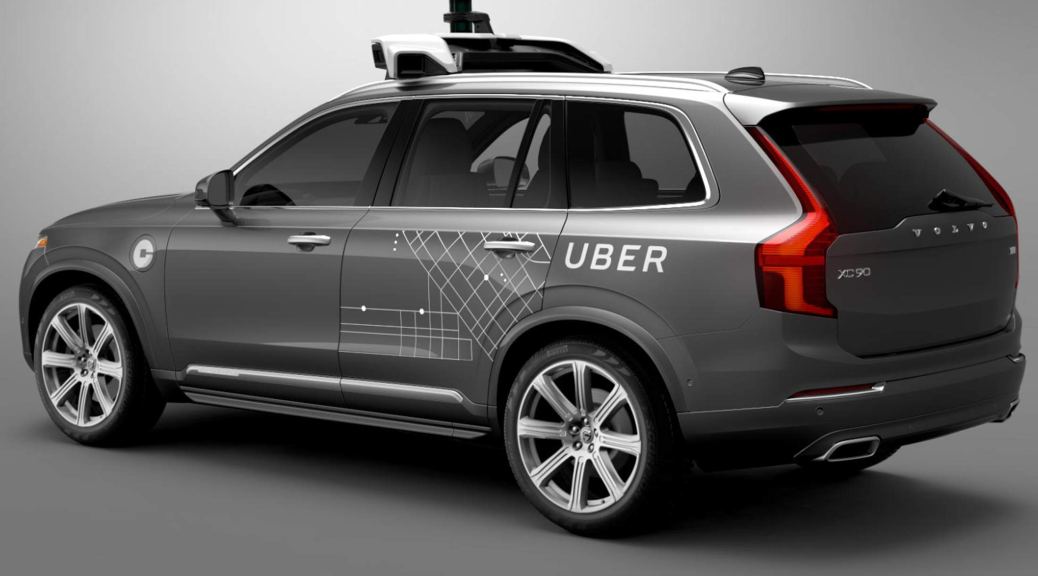
Bloomberg Starting later this month, Uber will allow customers in downtown Pittsburgh to summon self-driving cars from their phones, crossing an important milestone that no automotive or technology company has yet achieved. Google, widely regarded as the leader in the field, has been testing its fleet for several years, and Tesla Motors offers Autopilot, essentially a souped-up cruise control that drives the car on the highway. Earlier this week, Ford announced plans for an autonomous ride-sharing service. But none of these companies has yet brought a self-driving car-sharing service to market.
Uber’s Pittsburgh fleet, which will be supervised by humans in the driver’s seat for the time being, consists of specially modified Volvo XC90 sport-utility vehicles outfitted with dozens of sensors that use cameras, lasers, radar, and GPS receivers. Volvo Cars has so far delivered a handful of vehicles out of a total of 100 due by the end of the year. The two companies signed a pact earlier this year to spend $300 million to develop a fully autonomous car that will be ready for the road by 2021.
In Pittsburgh, customers will request cars the normal way, via Uber’s app, and will be paired with a driverless car at random. Trips will be free for the time being, rather than the standard local rate of $1.30 per mile. In the long run, Kalanick says, prices will fall so low that the per-mile cost of travel, even for long trips in rural areas, will be cheaper in a driverless Uber than in a private car. “That could be seen as a threat,” says Volvo Cars CEO Hakan Samuelsson. “We see it as an opportunity.”
For now, Uber’s test cars travel with safety drivers, as common sense and the law dictate. These professionally trained engineers sit with their fingertips on the wheel, ready to take control if the car encounters an unexpected obstacle. A co-pilot, in the front passenger seat, takes notes on a laptop, and everything that happens is recorded by cameras inside and outside the car so that any glitches can be ironed out. Each car is also equipped with a tablet computer in the back seat, designed to tell riders that they’re in an autonomous car and to explain what’s happening. “The goal is to wean us off of having drivers in the car, so we don’t want the public talking to our safety drivers,” Krikorian says.
The single cockiest move here is selecting Pittsburgh as the test city. I understand parts of the city are turning into the east coasts own Silicon Valley with its vast resources including some of the most elite colleges but I want to think whoever made this decision didn’t come from one of these elite institutions.
All of the cities out there laid out in a grid where all the turns are ideal lefts and right? Nah I prefer the city laid out like a triangle that’s surrounded by water on 2 sides. I want the city that has the second most bridges in the United States, that’s the perfect candidate.
In the social media age, everyone seeks some kind of fame. Youtube famous. Vine famous. Twitter famous. You want the fast track to fame? Go sit in one of these Uber’s next month for free and be the leading role in the headlines when one of these Volvos zigs instead of zags and ends up in a river.
Side note: If you think I’m getting into the back of a truly driverless Uber one day and sitting in the same seat 2 drunks almost certainly just banged in you’re out of your mind. All these advanced scientists focusing on the computer logistics of the operation, lets get a guy on the payroll who can build in some kind of toilet seat liner ajace technology I can pull out before getting in.
 TheYuppieYinzer